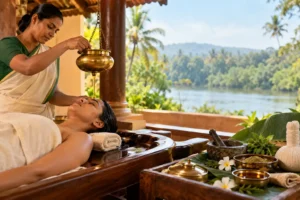
If you have looked into Ayurveda in Kerala, you have almost certainly come across the word Panchakarma, often described as a “detox”. But what is Panchakarma, really? It is not a spa treatment or a single massage. It is a structured, doctor-supervised programme that Ayurveda has used for centuries to cleanse the body and restore balance.
Because it is intensive, Panchakarma is also widely misunderstood. Some people expect a relaxing week of oil massages; others worry it will be harsh. The truth sits between the two. This guide explains what Panchakarma is, its five classical procedures and three stages, how long it takes, who it may suit, what the evidence says, and how to choose a centre, so you can decide whether it is right for you.
Panchakarma is Ayurveda’s system of therapeutic cleansing. The Sanskrit word combines pancha, meaning five, and karma, meaning action or procedure. Together, it refers to five classical procedures designed to remove excess doshas from the body.
In Ayurveda, health depends on the balance of three doshas: Vata (movement), Pitta (transformation and metabolism) and Kapha (structure and stability). When the doshas build up beyond their natural levels, Ayurveda describes the result as imbalance, often accompanied by ama, a term for undigested or accumulated waste. Panchakarma aims to loosen these excess doshas and expel them through the body’s natural routes.
In Ayurvedic practice, Panchakarma belongs to Shodhana (purification) therapy. It is different from Shamana (palliative) therapy, which calms symptoms with medicines and diet without a full cleanse.
These are traditional Ayurvedic concepts. They describe how Ayurveda understands the body, rather than established findings of modern medical science.
The five classical procedures are:
Vamana: Therapeutic emesis. A supervised process of induced vomiting, used in Ayurveda to clear excess Kapha from the upper body and respiratory tract.
Virechana: Therapeutic purgation. Herbal medicines are given to clear the bowels, traditionally used for excess Pitta and digestive concerns.
Basti (Vasti): Medicated enema. Herbal oils (Anuvasana Basti) or decoctions (Niruha Basti) are given rectally. Ayurveda regards Basti as the main therapy for Vata.
Nasya: Nasal therapy. Medicated oils or preparations are given through the nose, traditionally for conditions of the head, neck and sinuses.
Raktamokshana: Bloodletting. Listed in some classical texts; rarely used in modern wellness settings.
Classical texts count the five slightly differently. The Charaka Samhita counts the two types of Basti as separate procedures and does not include bloodletting. Other texts combine the two enemas and add Raktamokshana. In practice, no guest receives all five. Your doctor chooses the procedures your body needs, and many people receive two or three.
In Kerala, the word “Panchakarma” is also often used loosely for the state’s famous specialised therapies, such as Pizhichil (warm oil poured over the body) and Njavara Kizhi (rice bundle massage). These are valuable treatments, but in classical terms they are supportive or preparatory therapies, not the five cleansing procedures themselves. It is worth asking any centre which they mean.
A genuine Panchakarma programme follows three stages. Each matters as much as the cleansing itself.
Purvakarma prepares the body for cleansing. It usually includes:
Snehana (oleation): Taking measured doses of medicated ghee or oil by mouth over several days, combined with external oil massage.
Swedana (sudation): Herbal steam or heat therapies that help loosen the doshas.
Ayurveda holds that this stage moves the excess doshas towards the digestive tract, ready to be expelled. The doctor may also use herbs to improve digestion first.
This is when the selected procedures, such as Virechana or a course of Basti, are carried out. The doctor monitors your response closely and adjusts the plan from day to day.
After cleansing, digestion is considered delicate. Samsarjana Krama is a carefully graded diet, starting with thin rice gruel and slowly returning to normal food. Rest, routine and avoiding exertion are part of this stage. Skipping recovery is one of the most common mistakes, because it undoes much of the work.
A complete classical Panchakarma usually takes two to three weeks, although the right length depends on the person and the procedures chosen. Classical texts do not set a fixed number of days; the doctor continues each stage until the expected signs are reached.
As a guide:
Around 7 days allows a focused, introductory cleanse, usually with one main procedure.
14 days allows a fuller programme with proper preparation, cleansing and recovery.
21 days suits a more complete programme, particularly for long-standing concerns.
Be cautious of very short “Panchakarma” packages of two or three days. They may offer pleasant therapies, but there is rarely enough time for preparation, cleansing and recovery.
Ayurveda also links timing to the seasons. Classical guidance recommends Basti during the early monsoon, Virechana in autumn and Vamana in spring. This is one reason Kerala’s monsoon months are traditionally considered a good time for Ayurvedic treatment.
Within Ayurveda, Panchakarma is traditionally used to:
Support digestion and metabolism.
Reset eating and lifestyle habits.
Support the management of long-standing, lifestyle-related concerns.
Prepare the body for rejuvenation (Rasayana) therapies.
Encourage deep rest, mental calm and a sense of renewal.
Many people also value the structure of the stay itself: simple vegetarian food, early nights, no alcohol, and time away from screens and work.
Scientific research on Panchakarma is limited. A controlled study published in Scientific Reports in 2016 followed 119 healthy adults and found that a six-day Panchakarma-based programme changed certain blood markers, including a group of compounds linked to cholesterol. The researchers themselves noted that the changes were likely driven by the vegetarian diet, that the trial was very short, and that more research is needed.
The US National Center for Complementary and Integrative Health notes that, overall, few well-designed clinical trials support Ayurvedic approaches. Panchakarma should therefore be seen as a traditional wellness practice, not a proven treatment or cure for any disease.
Panchakarma is generally considered safe when it is carried out by qualified Ayurvedic doctors who assess you first and supervise every stage. It should never be done as a home “cleanse” or from online instructions.
Keep these precautions in mind:
It is not for everyone. Classical texts advise against cleansing for people who are weak, unwell or not strong enough to tolerate it. Panchakarma is usually not advised during pregnancy, acute illness or fever.
Tell the doctor everything. Share details of existing conditions, medicines, allergies, recent surgery and pregnancy.
Do not stop prescribed medication without speaking to the doctor who prescribed it. Ayurveda should not replace or delay necessary medical care.
Expect some tiredness. Cleansing procedures can leave you tired for a day or two. This should be monitored by your doctor.
Check where medicines come from. Health authorities in several countries have warned that some Ayurvedic products sold without proper quality control contain heavy metals such as lead, mercury or arsenic. Choose a centre that uses properly prepared and sourced medicines.
Kerala has hundreds of Ayurveda centres, so it helps to ask the right questions before you book:
Is there a qualified Ayurvedic doctor on site? Ask about qualifications, such as a BAMS or MD (Ayurveda) degree, and how often you will see the doctor.
Is there a consultation before treatment? Your plan should be based on your health, not a fixed package.
Which procedures are actually included? Ask whether the programme includes classical procedures such as Virechana or Basti, or mainly massage therapies.
Is there enough time for all three stages? Preparation and recovery are essential.
Is the diet prescribed? A proper Panchakarma includes a stage-by-stage diet.
Where do the medicines come from? In-house preparation or a licensed pharmacy is a good sign.
What happens after you leave? A take-home diet and lifestyle plan helps the results last.
At Layam, Panchakarma is offered through our Shodhana: Panchakarma Detox programme in Cheruthuruthy, beside Kerala Kalamandalam and close to the Bharathapuzha river. Shodhana runs over 7, 14 or 21 days, and every stay begins with a consultation with our Ayurvedic doctor.
Depending on what your body needs, the doctor may prescribe Vamana, Virechana, Vasti or Nasya, supported by preparation therapies, a prescribed diet for each stage and daily consultations. Not every guest receives every procedure, and the doctor recommends the length of stay after assessing you. You can see how Shodhana compares with our other residential stays on our Ayurveda programmes page.
If you are unsure whether Panchakarma suits you, our team can help you understand your options before you book.
So, what is Panchakarma? It is Ayurveda’s most complete cleansing therapy: a carefully planned sequence of preparation, cleansing and recovery, chosen for you by a qualified doctor. Done properly, it asks for time, rest and discipline, and it is very different from a short spa package that borrows the name.
If you are considering Panchakarma treatment in Kerala, start with honest questions about your health and goals. To discuss whether Shodhana is right for you, contact Layam to arrange a consultation before you plan your stay.
Panchakarma is a structured Ayurvedic cleansing programme. It uses up to five classical procedures, such as therapeutic purgation or medicated enemas, to remove what Ayurveda describes as excess doshas from the body. It is carried out in three stages: preparation, cleansing and recovery. A qualified Ayurvedic doctor decides which procedures you need.
A complete Panchakarma usually takes 14 to 21 days, including preparation and recovery. Around 7 days allows a shorter, focused cleanse. The right length depends on your health, goals and the procedures your doctor recommends after consultation, so it is best decided individually rather than chosen from a fixed package.
An Ayurvedic massage, such as Abhyangam, is a single therapy for relaxation and nourishment. Panchakarma is a full medical programme that may include massage and steam as preparation, but its core is the cleansing procedures, such as Virechana or Basti, followed by a recovery diet, all supervised by a doctor.
Panchakarma is usually not advised during pregnancy, acute illness or fever, or for people who are very weak or recovering from major illness. People with serious medical conditions should consult their own doctor first. A qualified Ayurvedic doctor should always assess you before starting, and may recommend a gentler programme instead.
Do not stop any prescribed medicine on your own. Bring your prescriptions and medical reports to your consultation. The Ayurvedic doctor will review them and advise how to plan treatment, and you should keep your regular doctor informed. Ayurveda should support, not replace, necessary medical care.
Panchakarma can be done throughout the year. Ayurveda traditionally links certain procedures to seasons, such as Basti in the early monsoon and Virechana in autumn. In Kerala, the monsoon months are traditionally regarded as a good time for Ayurvedic treatment, because the cool, moist climate is considered helpful for therapies.
It is best to rest throughout, especially during the cleansing and recovery stages, when the body may feel tired and digestion is delicate. Light walks are usually fine, but long trips, heavy meals and exertion are discouraged. Many people plan sightseeing before or after their programme instead.


Our Doors Are Open for Your Healing Journey
IV/290, Painkulam, near Kerala Kalamandalam, Vallathol Nagar, Cheruthuruthy, Kerala 679531, India
PEPCO Global Marketing and Management FZ-LLC
© 2026 PEPCO Group. Layam was formerly Nirvana Ayurveda Wellness Centre.