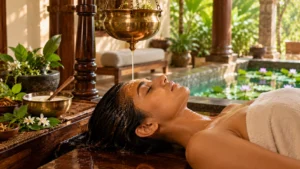
Lie down, close your eyes, and feel a slow, warm stream of liquid flowing gently across your forehead, back and forth, for the best part of an hour. That is dhara, one of Kerala’s most famous therapies, and many guests describe it as the deepest rest they have felt in years.
There are two main versions used for stress and sleep: Shirodhara, which uses medicated oil, and Takradhara, which uses medicated buttermilk. They look almost identical, so what is the real difference between Shirodhara vs Takradhara, and which one is right for you? This guide explains how each is made and given, what it feels like, and how an Ayurvedic doctor decides.
Dhara means “stream” or “flow”. In a dhara therapy, a liquid is poured in a continuous stream from a vessel hanging above the head. The therapist gently swings the vessel so the stream moves slowly from one side of the forehead to the other.
Shiro means head. Strictly, “Shirodhara” can describe any stream poured over the head. Classical texts and Kerala practice use different liquids for different needs: oil (Thailadhara), milk (Ksheeradhara), buttermilk (Takradhara) and herbal decoctions. When most people say “Shirodhara”, they mean the oil version, and that is how we use the term here.
Shirodhara is a stream of warm medicated oil poured over the forehead, usually for 30 to 45 minutes. It is often given after a gentle head and body massage. The oil is chosen by the doctor from classical formulations, based on your constitution and needs.
In Ayurveda, Shirodhara is traditionally used to calm Vata, the dosha associated with movement, the nervous system and, when out of balance, restlessness, worry and broken sleep. It is valued for its warming, grounding and nourishing quality.
What it feels like: Warm, heavy and soothing. Many people drift into a light sleep during the treatment.
Takradhara is a stream of medicated buttermilk poured over the forehead, usually for 45 minutes to an hour. The buttermilk is prepared specially: milk is boiled with Musta (nut grass), turned into curd, churned into buttermilk, and mixed with a decoction of Amalaki (Indian gooseberry).
Takradhara is traditionally considered cooling and is associated with calming Pitta, the dosha linked to heat, intensity and irritability. Classical teaching materials list its uses as including sleeplessness, headache, anxiety, mental stress and premature greying of hair.
What it feels like: Cool, light and refreshing. Some guests find it particularly pleasant in Kerala’s warmer months.
| Feature | Shirodhara (Oil) | Takradhara (Buttermilk) |
|---|---|---|
| Liquid | Warm medicated oil | Medicated buttermilk with Amalaki and Musta |
| Quality | Warm, heavy and grounding | Cooling and light |
| Traditionally used for | Vata-type stress, restlessness, worry, light or broken sleep and dryness | Pitta-type stress, heat, irritability, intense mental strain and difficulty falling asleep |
| Typical session | About 30–45 minutes | About 45–60 minutes |
| After the session | Oil is left in the hair for a while, then washed off | Head is cleaned; less oily |
| Often avoided in | Depending on the doctor’s judgement, heavy congestion and some head conditions | Fever, some eye conditions such as glaucoma or conjunctivitis, and cold intolerance |
These are general traditional guidelines. Your doctor makes the final choice.
An Ayurvedic doctor chooses based on you, not the name of the therapy. In a consultation, they look at:
Your constitution (Prakriti): Which dosha seems most out of balance.
The kind of stress you feel: Racing thoughts and worry may point one way; heat, anger and burnout another.
Your sleep pattern: Trouble falling asleep, waking at night, or waking unrefreshed.
Your body: Dry skin and feeling cold, or feeling hot and inflamed.
The season and your health: For example, Takradhara may be avoided if you have a cold or fever.
Some programmes use both on different days, or start with one and move to the other as you respond.
The evidence is promising but limited. A 2016 health technology assessment by Malaysia’s Ministry of Health reviewed Shirodhara for anxiety, insomnia and mental stress. It found only small, short-term studies. One showed improved insomnia scores; results for anxiety were mixed. The review concluded that Shirodhara by trained practitioners could be used as a complement to standard care, and called for more research. Studies on Takradhara are fewer still.
So Shirodhara and Takradhara are best seen as deeply relaxing traditional therapies that many people find helpful, not as cures for anxiety or sleep disorders. If you have a diagnosed condition or take medication for anxiety, depression or sleep, keep your regular doctor involved and don’t stop medicines without their advice.
Before: A short check with the doctor or therapist; sometimes a light head or body massage.
During: You lie on your back on a wooden treatment table, with your eyes covered and protected. The stream moves gently across your forehead. You simply rest.
After: You rest for a few minutes, the liquid is wiped or washed off, and you are advised to stay warm, avoid cold wind and bathe as directed.
For the rest of the day: Quiet activities, light food and an early night help you get the most from it.
A single session is relaxing, but dhara is traditionally given as a course over several consecutive days.
At Layam, beside Kerala Kalamandalam in Cheruthuruthy, both therapies are at the heart of Manashanti: Stress & Sleep, our 5 or 7-day programme for burnout and busy professionals. Your doctor chooses Shirodhara, Takradhara or a combination after your consultation, alongside Abhyangam, meditation and Nidra Yoga, and you leave with a simple daily routine for sleep and screen habits. You can see the full programme on our Ayurveda stress and sleep retreat page.
Shirodhara is also part of Eco-Rasayana: Rejuvenation, our gentlest programme for first-time guests.
Shirodhara vs Takradhara is not about which therapy is better; it is about which suits your body and your kind of stress. Shirodhara is warm and grounding, traditionally chosen for restless, Vata-type stress. Takradhara is cool and light, traditionally chosen for heat and Pitta-type intensity. Both are given best as a short course, as part of a calm routine, with a doctor guiding the choice.
If you’re struggling with stress or sleep and would like to know which suits you, contact Layam to arrange a consultation with our doctor.
Neither is simply better. Both are traditionally used for sleeplessness. Takradhara is considered cooling and is often chosen when stress feels hot and intense, while oil Shirodhara is warming and often chosen for restless, anxious minds. An Ayurvedic doctor decides which suits you after a consultation.
Dhara is usually given as a course, commonly over five to seven consecutive days, though your doctor may suggest more or fewer. One session can be very relaxing, but a course allows the effects to build. Your doctor will plan the number of sessions around your programme and response.
It has a mild, slightly sour, herbal aroma from the buttermilk, Amalaki and Musta. Most guests find it fresh rather than unpleasant, and it is cleaned off after the session. Unlike oil Shirodhara, it doesn’t leave your hair oily, which some guests prefer.
Your therapist will advise you. Usually the oil is left for a short time, then washed off with warm water and a herbal powder or mild shampoo. Avoid cold water, cold wind and air-conditioning directly on your head for the rest of the day, and keep your head covered if it is cool outside.
They may be postponed during fever, a cold or acute illness, and Takradhara is usually avoided with some eye conditions such as glaucoma or conjunctivitis. Pregnancy, recent head injury or surgery and certain medical conditions also need a doctor’s advice. Always tell the doctor about your health and medicines first.
When given by trained therapists under an Ayurvedic doctor’s guidance, they are generally considered gentle. Research on safety is limited; a few people report headache, chills or discomfort. Tell your therapist straight away if you feel cold or unwell during a session, so they can adjust or stop it.


Our Doors Are Open for Your Healing Journey
IV/290, Painkulam, near Kerala Kalamandalam, Vallathol Nagar, Cheruthuruthy, Kerala 679531, India
PEPCO Global Marketing and Management FZ-LLC
© 2026 PEPCO Group. Layam was formerly Nirvana Ayurveda Wellness Centre.