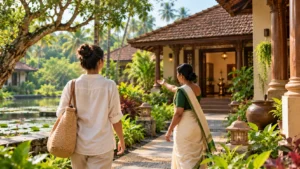
Kerala has hundreds of places offering Ayurveda: large hospitals, beach resorts with a spa, family-run centres and quiet retreats in the countryside. Their websites often look similar and use the same words: “authentic”, “traditional”, “Panchakarma”. So how do you choose an Ayurveda centre in Kerala that is genuinely right for you?
The best way is to ask questions before you book. A good centre will answer them clearly and without pressure. This guide gives you 10 questions to ask, explains why each one matters, and tells you what a good answer sounds like.
Before comparing centres, be clear about your goal. Ayurveda stays fall broadly into three types:
Relaxation: A few days of massages and rest. Many resort spas offer this.
Rejuvenation (Rasayana): A structured programme of classical therapies, yoga and diet, usually 3 to 7 days.
Treatment or Panchakarma: A doctor-led programme for a specific concern or deep cleansing, usually 7 to 21 days.
All three are valid. Problems start when a relaxation package is sold as treatment. Knowing what you want makes the questions below much easier to judge.
This is the most important question. Ask for the doctor’s qualification and how often you will see them. In India, Ayurvedic doctors hold a BAMS degree (Bachelor of Ayurvedic Medicine and Surgery), and many hold an MD (Ayurveda). They should be registered to practise.
A good answer: “Our doctor holds a BAMS / MD (Ayurveda) and will see you on arrival and regularly during your stay.”
Ayurveda is personal. Before any programme, the doctor should assess your health, your constitution (Prakriti), your digestion and any medical conditions or medicines. Treatment should be adjusted as a result.
Be cautious if: The package is fixed and paid for in full with no assessment, or the first person you meet is a therapist.
Ask for a day-by-day schedule or at least a list of therapies. “Ayurvedic massage” is vague; Abhyangam, Shirodhara, Pizhichil, Kizhi and Udwarthanam are specific. For Panchakarma, ask which of the main procedures, such as Virechana or Basti, may be included.
Length is a good honesty test. A three-day stay can be a lovely rejuvenation break, but a full classical Panchakarma usually needs 14 to 21 days for preparation, cleansing and recovery. A centre that promises deep results in three days is overselling.
Kerala therapies are skilled work. Ask how long the therapists have trained, and whether male guests are treated by male therapists and female guests by female therapists, which is the usual practice in Kerala.
Some centres prepare oils in-house; others buy from licensed Ayurvedic manufacturers. Either can be fine. What matters is that the source is known and regulated. Health authorities, including the US National Center for Complementary and Integrative Health, have warned that some Ayurvedic products sold online contain lead, mercury or arsenic.
A good answer: “Our oils are prepared by a named licensed manufacturer or in-house pharmacy, and we can tell you what is in each one.”
Food is part of treatment in Ayurveda. Ask whether meals are vegetarian, whether they are adjusted to your programme and constitution, and whether the doctor plans your diet. A resort buffet with an “Ayurvedic corner” is not the same thing.
In Kerala, the Department of Tourism classifies Ayurveda centres as Ayur Silver, Ayur Gold or Ayur Diamond, replacing the older Green Leaf and Olive Leaf ratings. Some Ayurveda hospitals also hold NABH accreditation for AYUSH hospitals.
Classification is a useful sign of facilities and standards, but it is not the whole story. Still ask about the doctor, the therapies and the medicines.
Ayurveda works best with rest. Ask about noise, the daily routine, whether alcohol is served, and whether there is space for quiet walks and yoga. A busy party resort makes it hard to follow a treatment routine, however good the therapies are.
A good centre gives you a simple plan for diet, routine and exercise to continue at home, and tells you if and when to follow up. Ask whether the doctor is reachable after your stay.
Be cautious if you notice any of the following:
Promises to cure serious conditions such as diabetes, cancer or infertility.
No doctor, or a doctor you cannot meet before treatment.
One package for everyone, regardless of health or goals.
Pressure to book more days or buy medicines on arrival.
Advice to stop your prescribed medication. Never stop prescribed medicines without speaking to the doctor who prescribed them.
Ayurveda can be done all year. Kerala’s monsoon, roughly June to September, is traditionally considered an ideal time for treatment because the cool, moist air is said to help the body absorb oils. October to March is drier and more comfortable for sightseeing. Your centre should advise on what suits your programme.
Layam is an Ayurveda centre in Cheruthuruthy, near Thrissur, beside Kerala Kalamandalam and the Bharathapuzha river. We built our programmes around the questions above:
Every stay begins with a consultation with our Ayurvedic doctor, who adjusts therapies, oils and diet for you.
Each programme lists its therapies by name, and the doctor reviews your progress during your stay.
Programmes run from 3 days (rejuvenation) to 21 days (Panchakarma, joint and spine care, weight management), so the length matches the goal.
Meals are Sattvic and vegetarian, planned around your programme.
You leave with a home plan for diet, routine and exercise.
You can compare all six of our stays, from Eco-Rasayana rejuvenation to Shodhana Panchakarma, on our Ayurveda programmes in Kerala page.
Choosing an Ayurveda centre in Kerala is easier when you know what to ask. Start with your goal, then check the doctor, the consultation, the named therapies, the programme length, the therapists, the medicines, the food, the classification, the setting and the aftercare. A centre that answers all 10 questions openly is one you can trust with your time and your health.
Have a question about which programme suits you? Contact Layam to speak with our doctor before you book.
In India, Ayurvedic doctors complete a BAMS degree (Bachelor of Ayurvedic Medicine and Surgery), a five-and-a-half-year course including internship. Many also hold an MD (Ayurveda) in a specialist area. They should be registered to practise. It is reasonable to ask a centre for its doctor’s qualifications before you book.
Not always. Some resorts offer relaxing Ayurvedic massages as part of a spa menu, while a dedicated Ayurveda centre is built around doctor-led programmes, a prescribed diet and a treatment routine. Both can be enjoyable; the difference is whether you want a holiday with massages or a structured programme.
It depends on your goal. Three to seven days suits rejuvenation and rest. Specific concerns such as joint pain or weight usually need 14 to 21 days, and a complete Panchakarma typically needs 14 to 21 days. A consultation with the doctor is the best way to decide.
Treatment is possible all year. The monsoon, roughly June to September, is traditionally considered ideal because the cool, humid climate is said to help the body respond to therapies. October to March is drier and better if you also want to travel. Ask your centre what suits your programme.
They are classification levels given to Ayurveda centres by the Department of Tourism, Government of Kerala, based on facilities and standards. They replaced the older Green Leaf and Olive Leaf ratings. Classification is a helpful sign of quality, but you should still ask about doctors, therapies and medicines.
Tell the Ayurvedic doctor about every medicine and supplement you take. Do not stop prescribed medicines without speaking to the doctor who prescribed them. A responsible centre will plan your treatment around your existing care rather than asking you to replace it.


Our Doors Are Open for Your Healing Journey
IV/290, Painkulam, near Kerala Kalamandalam, Vallathol Nagar, Cheruthuruthy, Kerala 679531, India
PEPCO Global Marketing and Management FZ-LLC
© 2026 PEPCO Group. Layam was formerly Nirvana Ayurveda Wellness Centre.