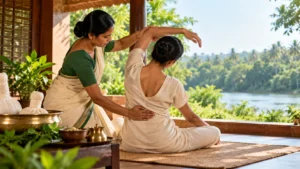
Back pain is one of the most common reasons people look for an Ayurveda programme in Kerala. Long hours at a desk, long-haul flights, heavy lifting or simply years of poor posture can leave the lower back and neck stiff, sore and tired.
Kerala Ayurveda has a well-developed set of therapies for the back, built around warm medicated oils, herbal bundles and gentle movement. This guide explains how Ayurveda for back pain works, the main therapies, what a programme looks like, what the evidence says, and, importantly, when you should see a medical doctor first.
Most back pain is not serious and improves with time and movement. But some symptoms need urgent medical attention, not a spa or Ayurveda treatment. Health services such as the UK’s NHS advise getting urgent medical help if back pain comes with:
Numbness or tingling around the genitals or buttocks.
Difficulty passing urine, or loss of bladder or bowel control.
Pain, weakness or numbness in both legs.
A high temperature, or unexplained weight loss.
Pain that is worse at night or doesn’t ease with rest.
Back pain after a serious fall or accident.
If any of these apply, see a doctor straight away. For ongoing pain, bring any scans or reports with you to an Ayurveda consultation.
In Ayurveda, most back pain is linked to an imbalance of Vata, the dosha associated with movement, dryness and the nervous system. Classical texts describe Kati Shoola (lower back pain) and Gridhrasi, a condition similar to sciatica, where pain travels down the leg.
From this point of view, factors that increase Vata, such as cold, dryness, irregular routine, long travel, poor sleep and too much sitting, can make back pain worse. Treatment aims to calm Vata with warmth, oil, rest and gentle strengthening.
These are traditional Ayurvedic explanations, not scientific diagnoses. A good Ayurvedic doctor will also ask about your posture, work, activity and any medical findings.
Kerala is known for therapies that bring warmth and oil directly to the painful area. The doctor chooses which ones to use and in what order.
Abhyangam: Warm Oil Massage
A full-body massage with warm medicated oil, often by two therapists working in rhythm. It relaxes muscles and prepares the body for other therapies.
Kati Basti: Oil Pooling on the Lower Back
A ring of dough made from black gram flour is placed on the lower back, and warm medicated oil is poured into it and held there for a set time, then gently massaged in. It is one of the best-known Kerala therapies for lower back pain. The same method on the neck is Greeva Basti.
Elakizhi and Podikizhi: Herbal Bundles
Warm cloth bundles filled with medicinal leaves (Elakizhi) or herbal powders (Podikizhi) are dipped in warm oil and pressed rhythmically over the back. They are traditionally used to ease stiffness, swelling and muscle spasm.
Pizhichil: Oil Bath with Massage
Warm medicated oil is poured continuously over the body while therapists massage in rhythm. It is one of Kerala’s classic treatments for joints, muscles and nerves, and is usually given as part of a longer programme.
Njavara Kizhi: Rice Bundle Massage
Bundles of Njavara rice cooked in milk and herbs are massaged over the body. It is traditionally used to nourish and strengthen muscles.
Basti: Medicated Enema
For long-standing Vata conditions, the doctor may prescribe a course of Basti, the medicated enema that classical texts consider the main therapy for Vata. It is not the same as Kati Basti, despite the similar name.
Marma Therapy and Physio-Yoga
Gentle work on marma, Ayurveda’s vital points, alongside therapeutic yoga and exercises to improve posture, flexibility and core strength.
A typical programme combines therapies, movement, diet and rest, adjusted as you respond:
Consultation: The doctor assesses your pain, posture, history and any scans.
Early days: Gentler therapies such as Abhyangam and Kizhi to reduce stiffness and pain.
Main phase: Focused therapies such as Kati Basti and Pizhichil; Basti if prescribed.
Strengthening: Physio-yoga and posture work increase as pain eases.
Going home: Exercises, posture tips and a routine to help prevent the pain returning.
Mild or recent pain may respond well to 7 days. Long-standing back or neck pain usually needs 14 days, and chronic or complex conditions 21 days.
Research on Ayurveda specifically for back pain is limited, and most studies are small. There is good evidence, however, that some elements found in a good Ayurveda programme, such as staying active, exercise, yoga and massage alongside exercise, can help many people with lower back pain. Clinical guidelines in the UK (NICE) recommend exercise as a core part of managing low back pain.
So the most realistic way to see Ayurveda for back pain is as a structured programme of warmth, rest, therapy and movement that many people find helps them feel better, not as a cure for spinal conditions. If you have a diagnosed disc problem, nerve symptoms or arthritis, keep your regular doctor or specialist informed.
Keep moving. Short walks are better than long periods of rest.
Break up sitting every 30 to 45 minutes.
Set up your desk so the screen is at eye level and your feet are flat on the floor.
Keep warm, especially your lower back, in cold weather or air-conditioning.
Strengthen your core with simple exercises or yoga you learned on your programme.
Sleep regularly and avoid very soft mattresses.
At Layam, beside Kerala Kalamandalam in Cheruthuruthy, back and neck pain is treated through Marma: Joint & Spine Care, a 7, 14 or 21-day programme. Your doctor reviews your history and any scans, then combines Pizhichil, Elakizhi or Podikizhi, Kati Basti and Greeva Basti, Marma therapy and physio-yoga, and reviews your progress regularly. You leave with posture guidance and exercises to continue at home. You can see the full programme on our Ayurvedic back and joint pain programme page.
Ayurveda for back pain in Kerala centres on warmth, oil, rest and movement: therapies such as Kati Basti, Kizhi and Pizhichil, combined with posture work and a routine you can keep at home. Rule out serious causes first, choose a doctor-led programme of the right length, and keep up the exercises when you return home.
To find out whether a back pain programme is right for you, contact Layam to arrange a consultation with our doctor. Bring any scans or reports you have.
Ayurveda cannot promise a cure, and no responsible centre should. Many people find that a programme of warm oil therapies, rest, exercise and posture work helps them feel better and move more easily. Results depend on the cause of the pain, so a proper assessment, including medical tests where needed, comes first.
Kati Basti is one of the most widely used Kerala therapies for lower back pain. Warm medicated oil is held over the lower back to soothe and relax the area. It is usually given as a course over several days and combined with other therapies and exercises, as chosen by an Ayurvedic doctor.
Mild or recent pain may respond to about 7 days. Long-standing back or neck pain often needs 14 days, and chronic or complex conditions such as arthritis may need 21. The doctor recommends a length after assessing you, and continuing exercises at home matters as much as the programme itself.
Ayurveda describes sciatica-like pain as Gridhrasi, and therapies such as Kati Basti, Kizhi and Basti are traditionally used for it. Evidence is limited. If you have a diagnosed disc problem, bring your scans, keep your specialist informed, and seek urgent care for leg weakness or bladder or bowel changes.
No. Most Kerala back therapies are warm and soothing. Herbal bundles are pressed firmly but should never burn, and Marma therapy uses gentle, precise pressure. Tell your therapist straight away if anything feels too hot or uncomfortable so they can adjust it.
Not without medical advice. Tell the Ayurvedic doctor about every medicine you take, and speak to the doctor who prescribed your painkillers before changing or stopping them. Your Ayurvedic doctor will plan treatment around your existing care.


Our Doors Are Open for Your Healing Journey
IV/290, Painkulam, near Kerala Kalamandalam, Vallathol Nagar, Cheruthuruthy, Kerala 679531, India
PEPCO Global Marketing and Management FZ-LLC
© 2026 PEPCO Group. Layam was formerly Nirvana Ayurveda Wellness Centre.